In late August 2025, FREED (Field Research in Ecology and Evolution Diversified) at their University of Toronto (UofT) chapter hosted their fourth annual weeklong event in Algonquin Park. FREED, created in 2020, was founded to provide accessible, barrier-free outdoor and fieldwork opportunities for Indigenous, Black, and/or Racialized (BIPOC) undergraduates. Experiencing the outdoors and nature can be formative in building a connection to the land and pursuing a career in a related field but these experiences are often inaccessible to underrepresented communities due to financial, societal, cultural, or other potential barriers.
I had the privilege of co-directing the program for the second year alongside Dr. Rachel Giles and a new team of leaders. As with every year I have been involved with FREED, I was filled with anticipation and eagerness for a season of exciting adventures, new memories, and expanding our community of FREEDlings (what we call our participants).
At the Algonquin Wildlife Research Station (AWRS), we welcomed a wonderful group of fifteen BIPOC undergraduate students bringing bright, inquisitive energy, teeming with excitement for the week to begin. The 7-day program was filled with activities to help students build skills and confidence in the outdoors and field work, as well as to build community and relationships amongst their peers and with the Land.
Workshops were led by graduate student researchers and professionals from various organizations, which included learning how to mist-net and band birds (Birds Canada), identifying bats by call in the nighttime (Toronto Zoo), learning of the history of the Land and Algonquin peoples (Christine Luckasavitch, Waaseyaa Consulting), and practicing how to safely use bear spray (Ontario Parks and Ontario Ministry of Natural Resources and Forestry).
Additional workshops included beach seining and observing fish caught in minnow traps, learning about Algonquin Park’s plant diversity, practicing multiple ways of knowing in conservation, aquatic ecology sampling from canoes and insect sampling and identification. These hands-on experiences enable students to gain knowledge and exposure to a breadth of topics and fields of study, empowering them to build a foundation leading to a potential career path.
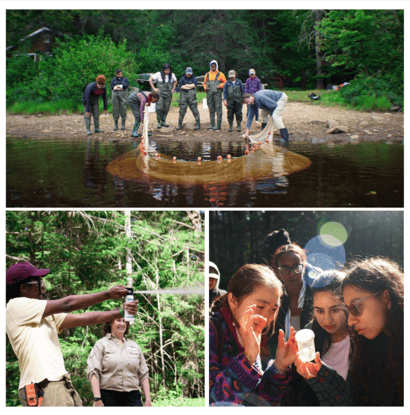
Top: Students using a beach seine in Lake Sasajewun for a fish workshop led by Dr. Nicholas Mandrak (UofT). Bottom Left: A student practicing with inert bear spray for a bear safety workshop with Lauren Trute (Ontario Parks) and Micheline Mamone (Ontario Ministry of Natural Resources and Forestry). Bottom Right: Bees and wasps workshop led by instructor Lydia Wong (PhD student at University of Ottawa). Photos by Averyn Ngan.
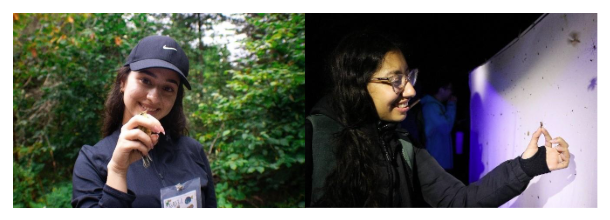 Left: A student holding a bird that was caught in a mist-net and banded with Brendan Boyd (Birds Canada). Right: A student observing nighttime visitors on a moth sheet with Alex Israel (Toronto Zoo) and Brendan Boyd. Photos by Averyn Ngan.
At the end of the week, students were asked to reflect on their experience by writing a thank you letter to the Land as FREED’s version of a land acknowledgement. Letters in hand and sitting in a sharing circle, heartfelt words were shared with gratitude and appreciation for the deep connections and relationships built with each other that was made possible by their experiences shared on the Land.
Over the years of seeing FREED expand and grow from its beginnings in 2020 and engaging with the incredible community the program has created, it has become clear to me how important programs such as these are for the future of the environmental sector.
Forestry is experiencing a labour shortage, which is only expected to increase in the next several years1. Forests Canada and the Ontario Forest Industries Association (OFIA) highlighted in their “Bridging the Gap” report series that a lack of awareness and exposure to the potential opportunities for careers in forestry as a major issue in this labour shortage2. Furthermore, Eco Canada identified that costs of tuition and certifications are key barriers to education and subsequently to entry into the environmental sector3. Programs, such as FREED, represent an opportunity to address these barriers and therefore the labor shortage.
Through hands-on experiential learning, fair compensation to increase accessibility, and environmental skills building, these programs are working to address the skills gap in the industry. Creating inclusive spaces for diverse voices and perspectives to be shared and celebrated can help expand ways of thinking and knowing to develop creative solutions to existing issues in forestry.
By setting up opportunities that encourage accessibility, inclusivity, and diversity, we can shape more pathways into forestry careers for youth, contributing to a sustainable and resilient forest industry into the future.
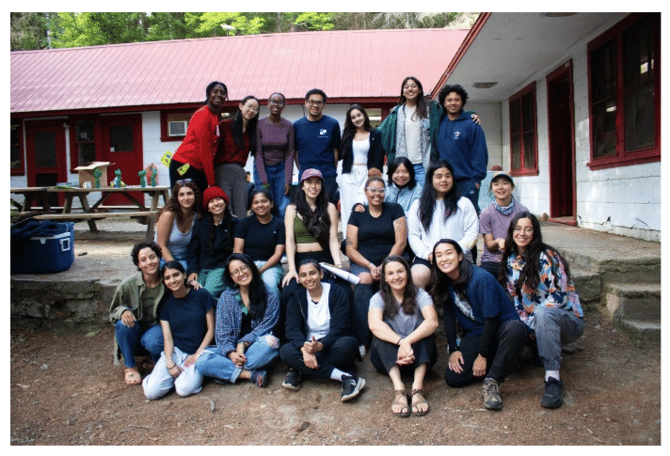
Group photo outside of the cookhouse at the Algonquin Wildlife Research Station. Photo by Averyn Ngan.
Previous summary reports of FREED events are available on our website here: www.freedalgonquin.wordperss.com.
Follow us on social media to stay up to date on our latest activities on LinkedIn, Instagram (@FREED_fieldwork) and Twitter (@FREED_fieldwork).


.jpeg)